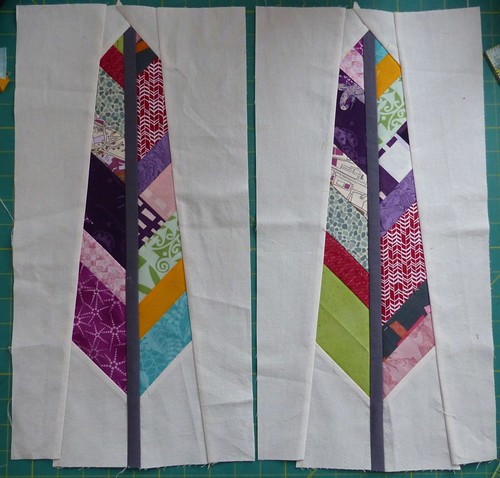
Last April, I showed you my test Feather block from Anna Maria Horner's Feather Bed Quilt, as well as some directions for doing this block as a bee block.
For this bee block, I provided the solid background (creams and beiges) and grey for the the feather spine. I asked my OMQG Bee mates to use medium value scraps for the feather edges.
I was tidying up my studio the other day and realized that I hadn't shared these beauties and that it was time to start working on this quilt again.
I am definitely "hearting" these blocks! Thanks bee mates!
I think I'll add more beiges to spread the feathers out and maybe make another block or two.
Showing posts with label Feather block. Show all posts
Sunday, 18 January 2015
Monday, 14 April 2014
Modern Block Monday - Feathers
I've loved Anna Maria Horner's Feather Bed quilt for some time. For my OMQG bee, I chose the Feather block. Now what I didn't realize when I chose it, is just how tricky it would be to figure out how to make just one block. According to the free pattern (Thank you, Anna!), one block contains two feathers. A friend gave me this great link that makes the feather cutting simpler. I fiddled with Meredith's measurements and figured out that 10" strips will make two feathers. Here is my practice block:
The making of the strip blocks for the feathers is fussy, but otherwise, it's a pretty straightforward block. I really love the look. I can't wait to see what my bee mates come us with.
In case there are some of you who just want to make two feathers (maybe for a bee or a pillow), here are the instructions I gave my bee mates:
Please read through all of the instructions before beginning.
Fabrics:
1 fat quarter of a background fabric (cream)
2 - 1" by 19" strips for the feather stem (grey)
Feather edges - A variety of 10” fabric strips of varying widths between 1.5”-3”. Bright, medium value fabrics work best.
Directions:
1) Print out and tape together the templates from Anna Maria Horner’s Feather Bed Quilt pattern.
2) For the feathers, use 10” strips in varying widths of 1.5-3”. You will need enough for your feather template to fit on (12” high is good). Follow this tutorial for assembling and cutting out your feather edges — it's more fabric economical than Anna Maria’s instructions.
3) Using the remaining templates, cut out 4 F pieces first, then 4 B pieces, 2 D pieces, and 2 E pieces from the cream background fabric.
4) Assemble the feather blocks according to Anna Maria’s pattern instructions on pages 4 and 5.
You should now have two feather blocks of approximately 18.5” by 9.5”.
Clear as mud? Feel free to post any questions or comments below.
The making of the strip blocks for the feathers is fussy, but otherwise, it's a pretty straightforward block. I really love the look. I can't wait to see what my bee mates come us with.
In case there are some of you who just want to make two feathers (maybe for a bee or a pillow), here are the instructions I gave my bee mates:
Please read through all of the instructions before beginning.
Fabrics:
1 fat quarter of a background fabric (cream)
2 - 1" by 19" strips for the feather stem (grey)
Feather edges - A variety of 10” fabric strips of varying widths between 1.5”-3”. Bright, medium value fabrics work best.
Directions:
1) Print out and tape together the templates from Anna Maria Horner’s Feather Bed Quilt pattern.
2) For the feathers, use 10” strips in varying widths of 1.5-3”. You will need enough for your feather template to fit on (12” high is good). Follow this tutorial for assembling and cutting out your feather edges — it's more fabric economical than Anna Maria’s instructions.
3) Using the remaining templates, cut out 4 F pieces first, then 4 B pieces, 2 D pieces, and 2 E pieces from the cream background fabric.
4) Assemble the feather blocks according to Anna Maria’s pattern instructions on pages 4 and 5.
You should now have two feather blocks of approximately 18.5” by 9.5”.
Clear as mud? Feel free to post any questions or comments below.
Subscribe to:
Posts (Atom)